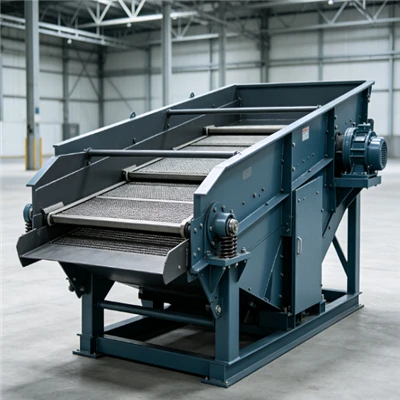
Industrial Vibrating Screen for Mining, Quarrying & Bulk Processing
A vibrating screen separates bulk materials by particle size through controlled vibration. It is widely used in crushing plants, mining operations, aggregate production, and recycling systems where stable classification and continuous material handling are required.
The correct vibrating screen selection depends on material characteristics, required capacity, screening accuracy, and plant configuration. We provide flexible options including multi-deck screening systems, inclined screens, horizontal screens, and fully customized screening solutions designed to meet specific processing conditions and international engineering standards.
-
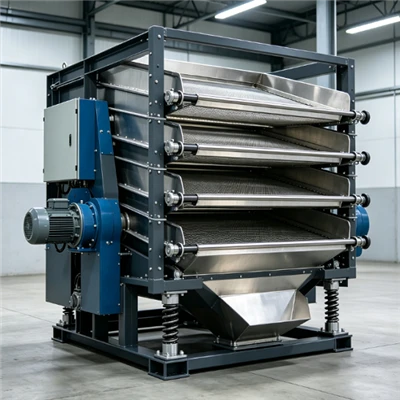
![Multi Layer Production Line Screening System]() Multi Layer Production Line Screening SystemThe Multi Layer Production Line Screening System is engineered for continuous bulk material classification across mining, quarrying, and industrial operations.
-
![Multi Layer Particle Separation Machine]() Multi Layer Particle Separation MachineThe Multi Layer Particle Separation Machine facilitates multi-stage classification for bulk materials across mining, quarrying, aggregate processing, and industrial material handling applications.
-
![Multi Layer Aggregate Screening System]() Multi Layer Aggregate Screening SystemThe Multi Layer Aggregate Screening System is engineered for multi-stage classification of crushed stone, gravel, and sand in industrial quarrying and mineral processing operations.
-
![Multi Layer Sand Screening Machine]() Multi Layer Sand Screening MachineThe Multi Layer Sand Screening Machine is engineered for multi-stage classification of sand and granular materials within quarrying, mining, and aggregate processing lines.
-
![Multi Layer Coal Classification Equipment]() Multi Layer Coal Classification EquipmentMulti Layer Coal Classification Equipment provides multi-stage screening and precise particle size separation for coal processing plants, mining operations, and bulk material handling systems.
-
![Multi Layer Ore Screening Equipment]() Multi Layer Ore Screening EquipmentMulti Layer Ore Screening Equipment is engineered for multi-stage classification of mined materials in mineral processing, quarrying, and aggregate production.
-
![Fine Plastic Granule Screening Machine]() Fine Plastic Granule Screening MachineFine Plastic Granule Screening Machine provides precise particle classification for plastic pellets and granules during recycling, compounding, and manufacturing operations.
-
![Fine Quartz Sand Screening Equipment]() Fine Quartz Sand Screening EquipmentFine Quartz Sand Screening Equipment is engineered for the precision classification of silica sand utilized in glass manufacturing, foundry operations, ceramic production, and high-purity mineral
-
![Fine Powder Screening System]() Fine Powder Screening SystemFine Particle Separation Equipment is designed for accurate classification and separation of fine granular and powder materials in mineral processing, industrial manufacturing, and material recycling
-
![Fine Particle Separation Equipment]() Fine Particle Separation EquipmentFine Particle Separation Equipment is engineered for the classification and separation of fine granular and powder materials across mineral processing, industrial manufacturing, and recycling
-
![Fine Sand Screening Machine]() Fine Sand Screening MachineFine Sand Screening Machine is designed for accurate classification and separation of fine sand materials in mineral processing, construction materials, and industrial production lines.
-
![Fine Mineral Powder Screening Equipment]() Fine Mineral Powder Screening EquipmentFine Mineral Powder Screening Equipment is engineered for the precise classification and separation of fine mineral materials in industrial powder processing environments.


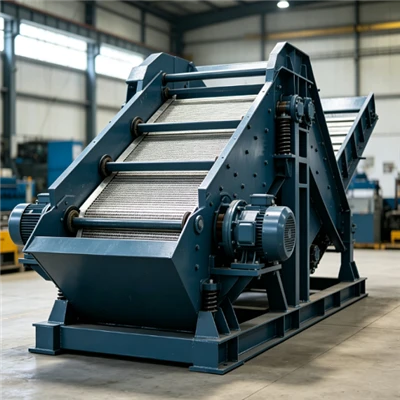
A vibrating screen consists of:
•Screen box
•Screen deck
•Vibration exciter
•Drive motor
•Supporting springs
•Screen media
•Structural frame
During operation, the vibration mechanism generates controlled movement, allowing materials to move across the screen surface while particles smaller than the opening pass through.
Vibrating Screen Types
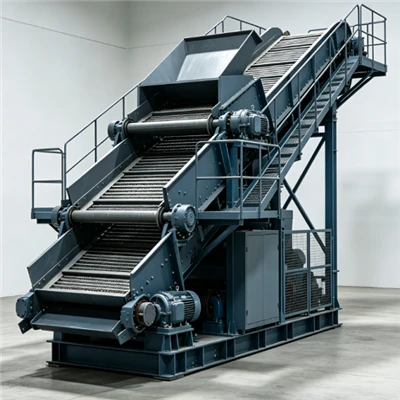
Inclined Vibrating Screen
Suitable for: Quarry operations, aggregate processing, and primary/secondary crushing plants.
Features: Inclined screening surface, high screening efficiency, and suitable for multi-stage classification.
Typical Applications: Crushed stone grading, sand and gravel separation, and mineral screening.
Horizontal Vibrating Screen
Suitable for applications requiring: Lower installation height, precise material handling, and flexible plant layouts.
Commonly used in: Mining plants, industrial mineral processing, and heavy-duty recycling systems.
Linear Vibrating Screen
Core function: Uses linear vibration movement to efficiently transport and classify fine materials.
Applications: Fine screening, powder materials, chemical products, and industrial materials processing.
Dewatering Vibrating Screen
Designed for: Removing water from processed materials, reducing moisture content, and improving material recovery rates.
Common Applications: Sand washing plants, wet mineral processing, and high-efficiency aggregate production.
Key Technical Specifications
Screening Layers: Single / Double / Multi-Deck (customizable)
Screen Area: Engineered according to your capacity requirements (e.g., 50 TPH to 1000+ TPH)
Processing Capacity: Selected precisely based on material type and application
Feed Material Size: Customized based on your production line specifications
Screen Media Options: Woven wire mesh, polyurethane panels, or rubber panels
Drive System: Heavy-duty motor-driven vibration mechanism
Installation Type: Fixed installation or integrated mobile plant design
How to Select the Right Vibrating Screen
Define Material Characteristics
Before equipment selection, evaluate material type, hardness, moisture content, bulk density, and particle size distribution.
Example: Hard abrasive stone requires high-wear-resistant screen components, while high-moisture materials require anti-blinding solutions.
Confirm Required Capacity
Capacity selection depends on feed rate, material properties, required output size, and target screening efficiency. Oversized equipment increases initial investment costs, while undersized equipment reduces overall plant production efficiency.
Select Screen Configuration & Media
Number of Decks: Single deck (basic separation) / Double deck (two-size classification) / Multi-deck (multiple product grades simultaneously).
Screen Media Choice: Woven wire mesh, polyurethane panels, or rubber screen panels to maximize wear life and screening performance.

Manufacturing & Quality Control
Reliable vibrating screen performance depends on strict manufacturing accuracy and rigorous component quality control.
Structural Fabrication:
Welded frame inspection, dimensional accuracy checking, and professional stress-relief control during fabrication.
Mechanical Component Control:
Precision inspection of vibration exciters, heavy-duty bearings, drive systems, and high-tensile fastening components.
Pre-Shipment Assembly Testing:
Rigorous factory testing for vibration stability, operating noise levels, component alignment, and overall mechanical performance.
Application Industries
Mining:
Ore classification, mineral separation, and process preparation.
Quarry & Aggregate:
Crushed stone grading, sand production, and construction aggregate processing.
Recycling:
Construction waste sorting, material recovery, and precise size classification.
Coal & Energy Materials:
Particle separation and heavy-duty material handling systems.
Why Choose Us as Your Global Partner
Engineering Capability:
Comprehensive equipment selection support, professional technical drawings, customized configuration recommendations, and project-based solutions.
Manufacturing Capability:
Strict fabrication quality control, reliable global component sourcing, advanced assembly capability, and rigorous factory testing procedures.
After-Sales Support:
Guaranteed spare parts availability, professional maintenance guidance, remote or on-site installation support, and prompt technical response capabilities.
FAQ
We're well-known as one of the leading vibrating screen manufacturers and suppliers in China, specialized in providing high quality customized service for global clients. We warmly welcome you to buy high-grade vibrating screen made in China here from our factory.
Equal Thickness Screen, vibrating screen, Environmentally Friendly Vibrating Screen